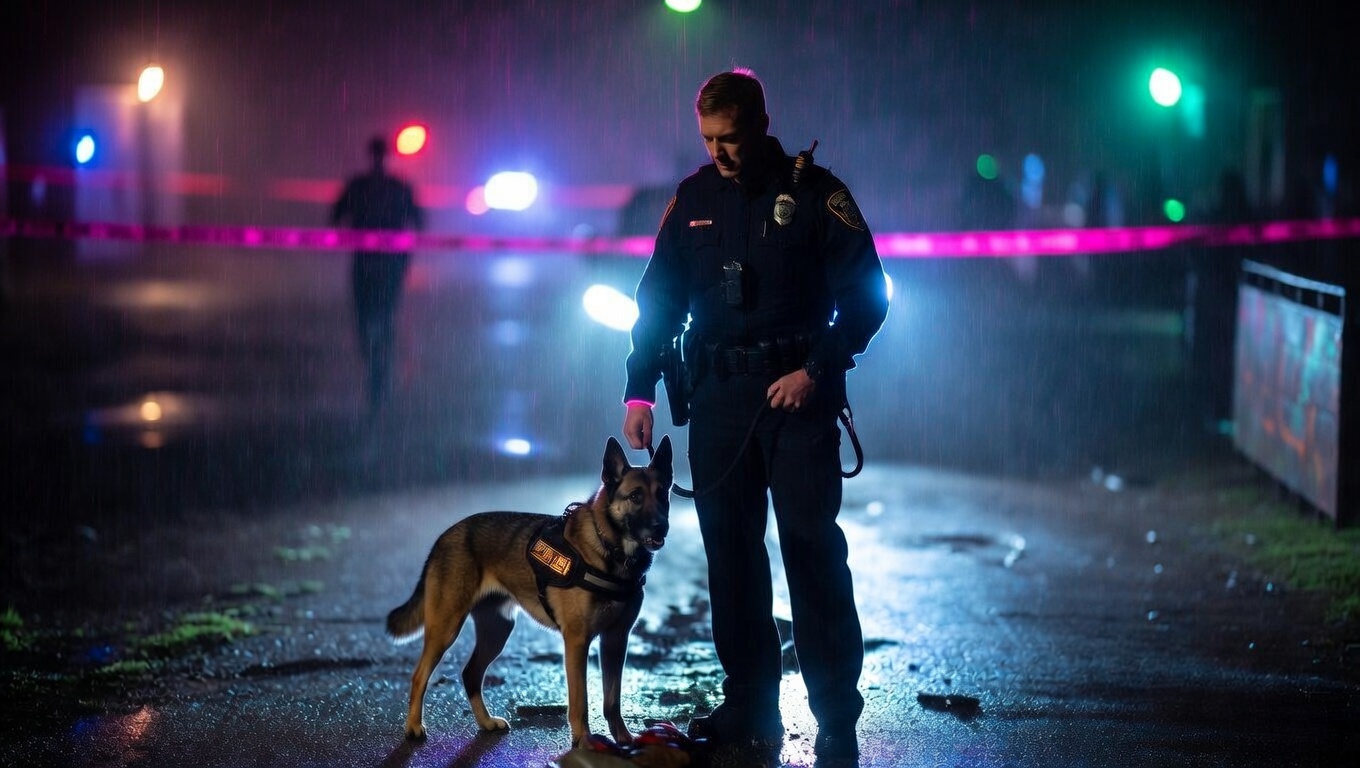
A working K9 handler learns the law in one of two ways.
The first way is a defense attorney standing up six months after a deployment and saying, on the record, something the handler has never heard before — a phrase like Rodriguez moment or de minimis exception or handler cueing effect — followed by a ruling that walks the heroin back out the door with the defendant.
The second way is this page.
We have read the opinions so you can. Every case below has a live URL to the actual ruling, because hand-waving at case law is the same problem documented handlers face on cross-examination. The goal isn't to scare you. It's to show you exactly what the doctrine rewards, exactly what it punishes, and exactly how narrow the line is between the two. In the handler's favor: the line is also well-documented. Once you see it, you can stay on the right side of it.
Uncomfortable Truths
Six things the case law says that handlers are rarely told.
Every number below comes from a published opinion, a DOJ review, or a peer-reviewed study. Every one of them changes how a careful handler writes a report.
Part One · Certification saves you
The dog was wrong a lot. The handler still won.
These are the cases prosecutors cite when the defense attacks field performance. In each, the handler brought certification plus specific training records — and the court declined to let raw numbers defeat them.
United States v. Bentley
795 F.3d 630 (7th Cir. 2015)
“Lex would have been at the bottom of his class had the Canine Training Institute calculated class rank.”
United States v. Ludwig
641 F.3d 1243 (10th Cir. 2011)
“A dog's credentials provide a bright-line rule for when officers may rely on the dog's alerts — a far improvement over requiring them to guess whether the dog's performance will survive judicial scrutiny after the fact.”
United States v. Martinez
102 F.4th 677 (5th Cir. 2024)
The question — similar to every inquiry into probable cause — is whether all the facts surrounding a dog's alert, viewed through the lens of common sense, would make a reasonably prudent person think that a search would reveal contraband or evidence of a crime.
Part Two · Certification doesn't save you
The paper was current. The handler's words sank the case.
The Harris presumption is rebuttable. These are the cases where the defense knocked it down — not by attacking the certification, but by attacking the handler's own description of what the dog did.
United States v. Heir
107 F. Supp. 2d 1088 (D. Neb. 2000)
“Objectively observable behavior — that is, indication behavior — must be established in connection with proof of adequate training.”

Part Three · The Rodriguez clock
A single minute controls the outcome.
Rodriguez v. United States (2015) held that a traffic stop cannot be extended — even briefly — for a dog sniff absent independent reasonable suspicion. Since then, every federal circuit has litigated what 'extended' means down to the minute. Three real cases, same question, different outcomes.
Three timelines · Same question · Three outcomes
Minute-by-minute CAD log. The detective was still writing when the dog alerted. Sniff did not extend the stop. Two kilos of cocaine admitted.
Unexplained 25-minute gap between the last documented task and the K9 deployment. Unanimous suppression. The record's silence was treated as extension.
The officer testified at the hearing that he stopped writing the citation to help with the K9. That single admission, in his own words, was fatal. No de minimis exception.
A single minute of documented activity saves a case. A single admission on cross-examination ends one.

Part Four · The civil side
In Section 1983 court, the missing record is the deciding record.
Criminal cases hinge on suppression. Civil cases hinge on qualified immunity and Monell municipal liability — both of which scrutinize training, policy, and documentation more aggressively than criminal discovery ever does. The cases below show what happens when that scrutiny lands.
Vathekan v. Prince George's County
154 F.3d 173 (4th Cir. 1998)
“It was clearly established that failing to give a verbal warning before releasing a police dog is objectively unreasonable.”
Becker v. Elfreich
821 F.3d 920 (7th Cir. 2016)
Luethje v. Kyle
2025 WL 851085 (10th Cir. 2025)
Part Five · The paradox
The honest handler is the protected handler.
Florida v. Harris created the strangest incentive structure in Fourth Amendment law: it made transparent documentation of training failure the strongest evidence of a dog's reliability. The handler who hides failures weakens the record. The handler who logs them strengthens it. Most handlers have never been told this.
A dog with a 100% success rate in training has, in practice, never been meaningfully tested. A defense attorney knows this. A judge under-the-robe knows this. The handler who submits a training record showing every exercise perfect has handed the defense an attack vector: the training was too easy, or the records are fabricated.
A dog with a 94% success rate, where the 6% includes documented entries like “K9 did not alert on hide #3 — wind interference suspected — remedial training scheduled for 06/15”, is the dog with the stronger record. The failure plus the remedial plan plus the follow-up is evidence of systematic quality control. Systematic quality control is what Harris rewards.
This is the rare case where the technology's incentives align cleanly with the ethical outcome. The handler who documents failures honestly isn't just being upstanding; they're being strategically optimal. They are producing the evidence that wins the reliability hearing they may never have.
PawTrek's training log was designed specifically around this insight. The training failure prompt does not hide from failure; it escorts the handler through documenting it, pairs it with a remedial plan, and makes the follow-up visible on the home screen. That is not a compliance feature. That is a court-defensibility feature dressed as a training feature.
The attack playbook
What defense attorneys actually ask in 2026.
Ten attack vectors drawn from the fifty cases in our research. Every one of them has a corresponding document a prepared handler can produce. Every one of them has produced a suppression somewhere.
“Who exactly certified your dog, and is that organization bona fide?”
Current certification from a named, recognized body with a known curriculum.
“Of your dog’s last hundred alerts, how many produced contraband?”
Per-alert context: residual odor, prior intelligence, known distribution points.
“Did you know the handler’s body language can make the dog alert at will?”
Documented double-blind training methodology with dated records.
“Describe exactly what your dog does when it’s interested but not alerting.”
Trained final response defined in behavioral terms; consistent across all prior reports.
“Minute by minute, Officer, what were you doing during the stop?”
CAD-synced timestamps; active task documented at the moment of sniff.
“Is your dog trained on marijuana, and can it distinguish hemp from marijuana?”
Per-dog scent list, dated, matching the certifying body’s curriculum.
“Did you announce before releasing the dog? Exact words. Repetitions. How much time.”
Verbatim warning script captured at time of deployment.
“When did contact begin? When did you command ‘out’? When did release occur?”
Three timestamps minimum; ideally tied to body-cam reference.
“Here is a thirty-day gap in your log. Explain.”
Continuous training-session records, contemporaneous, specific.
“Your report says X. The body-cam shows Y. Reconcile for the jury.”
Narrative drafted in explicit awareness of body-cam timeline, second by second.

The prepared handler
The composure of a handler who has already done the work.
The cross-examination doesn't worry him because the record doesn't. Every field was populated at the moment of memory. Every training session is logged in cadence. Every alert is described the same way he's described it four hundred times before. He walks the courtroom at an even pace, answers the question asked, and sits back down. This is what the twelve items below produce.
The loadout
Twelve artifacts every K9 handler should walk into court with.
Synthesized from every case on this page. Anything PawTrek doesn't produce, the handler produces in another form — paper binder, PDF printout, Word document, or memory. Items are not optional; they are the baseline for surviving modern cross-examination.
Current certification package from a recognized body.
12 months of training logs with specific exercises and results.
Handler résumé — POSTs, academies, seminars, books read.
Deployment history for this K9 — alerts, finds, and alerts without recovered finds, each with context.
Per-dog scent list — what substances this specific K9 is trained to detect.
The deployment report for this incident — every field populated.
Body-cam footage of the deployment, timestamps matching the report.
Dispatch/CAD log — the minute-by-minute objective record.
Training-aid chain of custody for detection cases.
Prior-bite history for patrol K9 with supervisor review disposition.
Deployment demographics — for defensive statistics against bias claims.
Jurisdiction-specific case-law digest controlling this deployment.

The throughline
Across fifty cases, the pattern is the same.
The handler with good documentation wins. Harris protects the handler who has certification. Parada protects the handler who describes the dog's behavior in specific terms. Martinez protects the handler whose training records are bi-weekly and up to date. Goodwill protects the handler whose CAD log shows minute-by-minute activity.
The handler with bad documentation loses even when the dog was right. Heir suppressed because the alert was only visible to the handler. Clayborne suppressed because the officer admitted he stopped writing the citation. Arrieta suppressed because of a twenty-five-minute silence. Luethje denied qualified immunity because no proportionality record existed.
The documentation that doesn't exist is the documentation that destroys. Courts, juries, prosecutors, and defense attorneys all treat absence as evidence of the negative. The handler who didn't log last Tuesday's training is a handler whose dog was presumptively not trained last Tuesday. The handler whose deployment report doesn't list the verbal warning is the handler who presumptively didn't give one.
PawTrek exists in this gap. Every feature we ship either narrows it or doesn't matter.
Every case cited has a live URL to the actual opinion. Nothing on this page was written from memory. Where a case could not be verified against a primary source, it was kept out. News-reported settlements and administrative actions are flagged as such.
For the full research document — 50+ cases organized by pattern, with detailed reasoning and implications for PawTrek's Evidentiary Defensibility framework — see the companion research file in the PawTrek repository.
Not legal advice. K9 handlers, agencies, and prosecutors should consult qualified counsel for jurisdiction-specific questions. PawTrek's citation-lock system prevents AI from fabricating case law, but handlers remain the author of record on every deployment report they submit.